Self-Coached Running: How to Build and Manage Your Own Training Plan
You already know how to train. Here's how to structure it, build toward a race, and manage the whole thing without the noise.

At some point, a lot of runners reach the same conclusion.
The generic 16-week plan worked once. The coaching app felt like progress for a while. But now you're staring at a schedule that doesn't account for how your legs felt on Thursday, the race you're actually targeting, or the fact that you've been running for four years and already know what works for you.
Self-coached running isn't a fallback. For a certain kind of runner, it's the right choice — and it always has been. Yuki Kawauchi won the 2018 Boston Marathon while working a full-time government job and coaching himself. He's an outlier in professional running — and proof that deep self-knowledge and consistent principles can outperform expensive infrastructure.
This guide covers how to do it properly: how to structure your weeks, how to build toward a race, how to adapt when things go sideways, and how to manage the whole thing without it becoming its own job.
What “Self-Coached” Actually Means
Let's be clear about what self-coached running is and isn't.
It isn't winging it. It isn't ignoring your body until something breaks. And it isn't printing a plan off the internet and following it blindly because someone said it worked for them.
Self-coached running means you understand the principles well enough to apply them to your own situation. You know that easy days should actually be easy. You know that building too fast is how injuries happen. You know your body well enough to tell the difference between fatigue that needs rest and discomfort that's just part of training.
That kind of knowledge doesn't come from an algorithm. It comes from paying attention over time.
What most runners who've been at it for a few years actually need isn't more coaching. It's a cleaner system for organising what they already know. A way to build a plan that reflects their life, their race schedule, and their current fitness. And a way to execute it without the plan living in three different places at once.
That's what this guide is about.
Easy Days and Hard Days
If there's one principle that underpins everything else in endurance training, it's this: most of your running should be easy, and the hard days should actually be hard.
Sports scientist Dr Stephen Seiler spent years studying how elite endurance athletes actually train. What he found was consistent across sports: roughly 80% of training time at low intensity, 20% at high intensity, and very little in between. Not because coaches invented the model — but because that's what the data showed the best athletes were already doing.
The mistake most runners make isn't running too little. It's running too much of their mileage at medium effort — hard enough to accumulate fatigue, not hard enough to drive meaningful adaptation. It feels like training. It often isn't.
The practical version of this is straightforward. In a typical training week:
- Easy runs should feel genuinely comfortable. You can hold a conversation. Your heart rate stays low. These runs build your aerobic base, support recovery, and make up the majority of your volume.
- Hard sessions — intervals, threshold runs, progression runs — are where you push. These are short in number, high in quality, and only effective if the easy days have been easy enough to allow real recovery.
- The long run sits in its own category: easy in effort, significant in duration. It's the cornerstone of marathon training in particular.
The research on polarised training makes one thing clear: the grey zone — that moderate-hard pace that feels productive — is where most amateur runners spend too much time, and where gains go to stall.
Getting this right doesn't require a coach. It requires honesty about what easy actually means.

Periodisation: Building Toward Something
Running the same kind of week on repeat will get you fit to a point. After that, it just maintains you. If you're training for a race, you need structure over time — not just structure within a week.
That's what periodisation means. It's the idea that your training should change shape as race day approaches, moving through distinct phases rather than staying constant. It's one of the most well-established principles in endurance coaching, and it's entirely manageable without a coach once you understand what each phase is doing.
The broad arc looks like this:
Base phase. This is where you build the foundation — consistent mileage, mostly easy, no heroics. The goal is aerobic development and injury resilience. Skipping this phase and jumping straight into hard work is the most reliable way to get hurt four weeks into a training block.
Build phase. Mileage continues to grow and quality sessions become more specific. You're introducing the types of effort that relate to your goal race — threshold work for a marathon, shorter intervals for a 5K. This is where fitness actually accumulates.
Peak phase. Volume starts to pull back slightly. Sessions become sharper and more race-specific. You're not trying to get fitter here — the work is done. You're converting fitness into readiness.
Taper. The final two to three weeks before a race. Mileage drops significantly, intensity stays present in small doses. Most runners taper too little or feel so restless they add junk miles back in. Resist that.
One pattern worth building in explicitly: the cutback week. Every three to four weeks, drop your volume by around 20–30% before resuming the build. It feels counterintuitive when training is going well, but adaptation happens during recovery, not during the hard weeks. Skipping cutbacks is one of the most reliable ways to arrive at race day already tired.
Jack Daniels' Running Formula — one of the most referenced books in the sport — lays out this phased approach in detail, with each phase building logically on the last. The specifics vary by race distance and fitness level, but the underlying structure holds across almost every serious training methodology.
The self-coached runner doesn't need to follow Daniels to the letter. But having this arc in mind — base, build, peak, taper — gives every training block a shape. And a plan with a shape is much easier to manage than one that's just a list of runs.
Adapting on the Fly
A training plan is a forecast, not a contract.
The runners who get the most out of self-coaching aren't the ones who follow their plan most rigidly. They're the ones who know when to follow it and when to deviate — and can tell the difference between the two.
That's a skill no algorithm has reliably solved. An app can see your heart rate. It can't feel the difference between heavy legs from a hard week of training and heavy legs from poor sleep, a stressful few days at work, or the early signs of illness. You can.
A few practical principles for adapting without losing the thread:
Missing a session isn't a crisis. One skipped run doesn't meaningfully affect a training block. Trying to cram it back in later, or doubling up to compensate, often does. Let it go and move forward.
A bad week happens. If your body isn't responding — persistent fatigue, flat efforts, elevated resting heart rate — take an unplanned easy week. The fitness you've built doesn't disappear in five days. It does if you push through and break down.
Adjust the session, not the goal. If you're due a threshold run and you feel off, run easy instead. Don't scrap the week — just change the day. The goal race stays fixed. The path to it can flex.
Trust the pattern, not the individual day. Fitness is built over weeks and months. A single bad session means almost nothing. A pattern of bad sessions means something. Learn to tell the difference.
This is where self-coached runners have a genuine edge. The feedback loop between what you feel and what you do is immediate — no waiting for a coach to respond, no algorithm recalibrating overnight.

The Missing Piece: Managing the Plan
Most self-coached runners have the knowledge. What they're missing is a clean system.
The plan ends up in a spreadsheet. Or a notes app. Or a training journal that's half-filled in. The workouts exist somewhere, but getting them organised, scheduled, and in front of you on the right day involves more friction than it should. And when the plan lives in three places at once, it's harder to follow and easier to abandon.
This is the part of self-coached running that doesn't get much attention — not the training principles, but the infrastructure. The gap between having a plan and actually executing it.
That's the problem Singlet is built to solve.
You can import an existing plan — whether that's something you've used before, a plan from a coach, or one you've found online — and Singlet structures it into a proper training calendar. If you prefer to build as you go, adding sessions week by week as your training evolves, that works too. The plan lives in one place, it's easy to adjust, and it's always current.
The point isn't to tell you how to train. You already know that. It's to remove the admin that gets between you and the running.
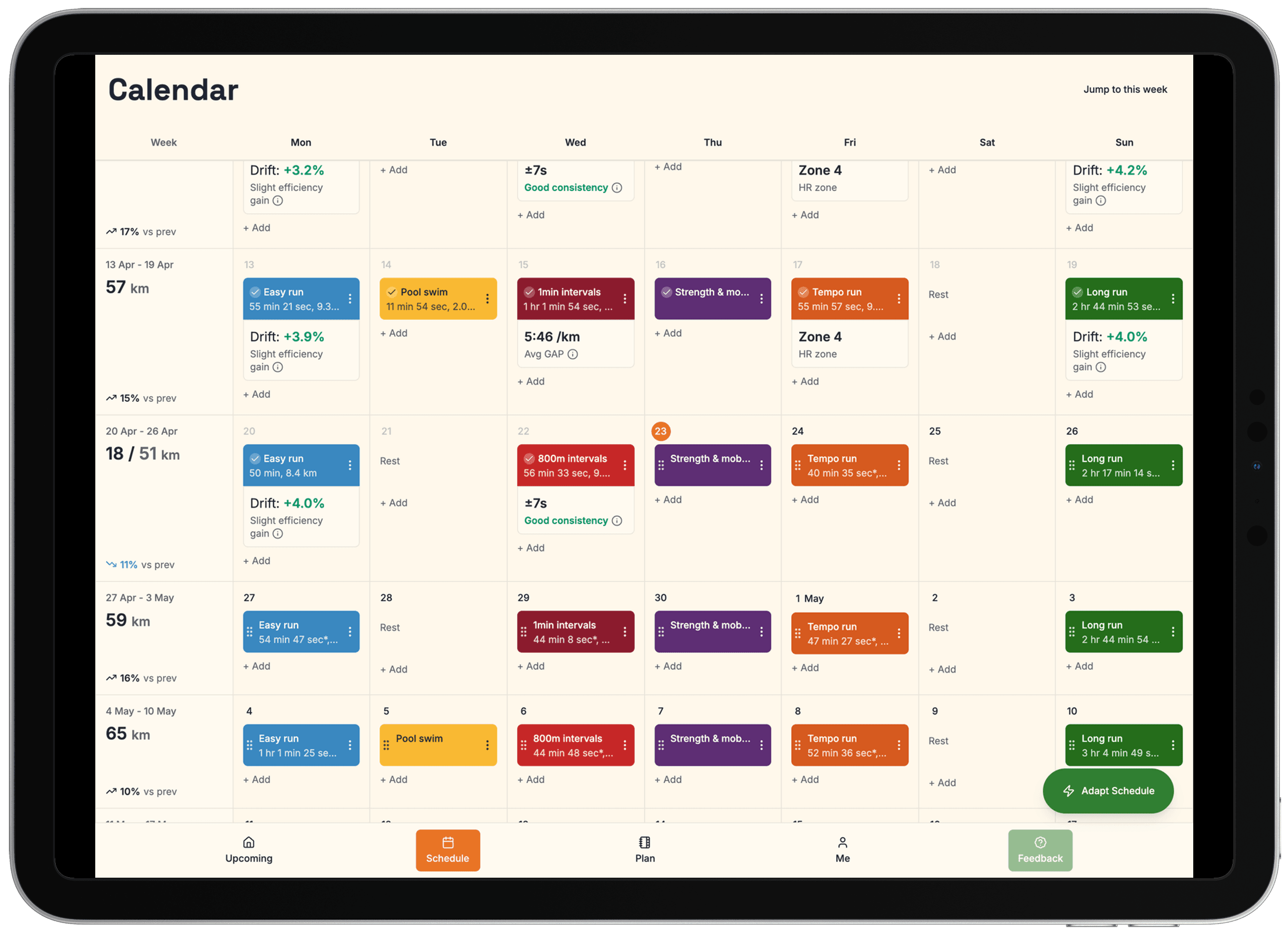
Watch Sync & Execution
Building a plan is one thing. Getting it onto your watch without manually entering every session is another.
Singlet syncs your training plan directly to Garmin Connect, so each workout shows up on your watch on the right day, ready to go. No transcribing sessions the night before. No checking your phone mid-run to remember the interval structure. The plan you built is the plan you run.
See how Singlet works with your Garmin →
Conclusion
Self-coached running works because you do. You pay attention, you adapt, you make decisions based on how your body actually responds rather than what a generic schedule says you should be doing.
The principles aren't complicated. Easy days easy, hard days hard, a sensible build toward your race, and the judgment to adjust when you need to. Most runners who've been at it for a few years already understand this. What they often lack is a clean place to put it all together.
That's what Singlet is for. Built for self-coached runners — not to tell you how to train, but to give you the system to do it properly.